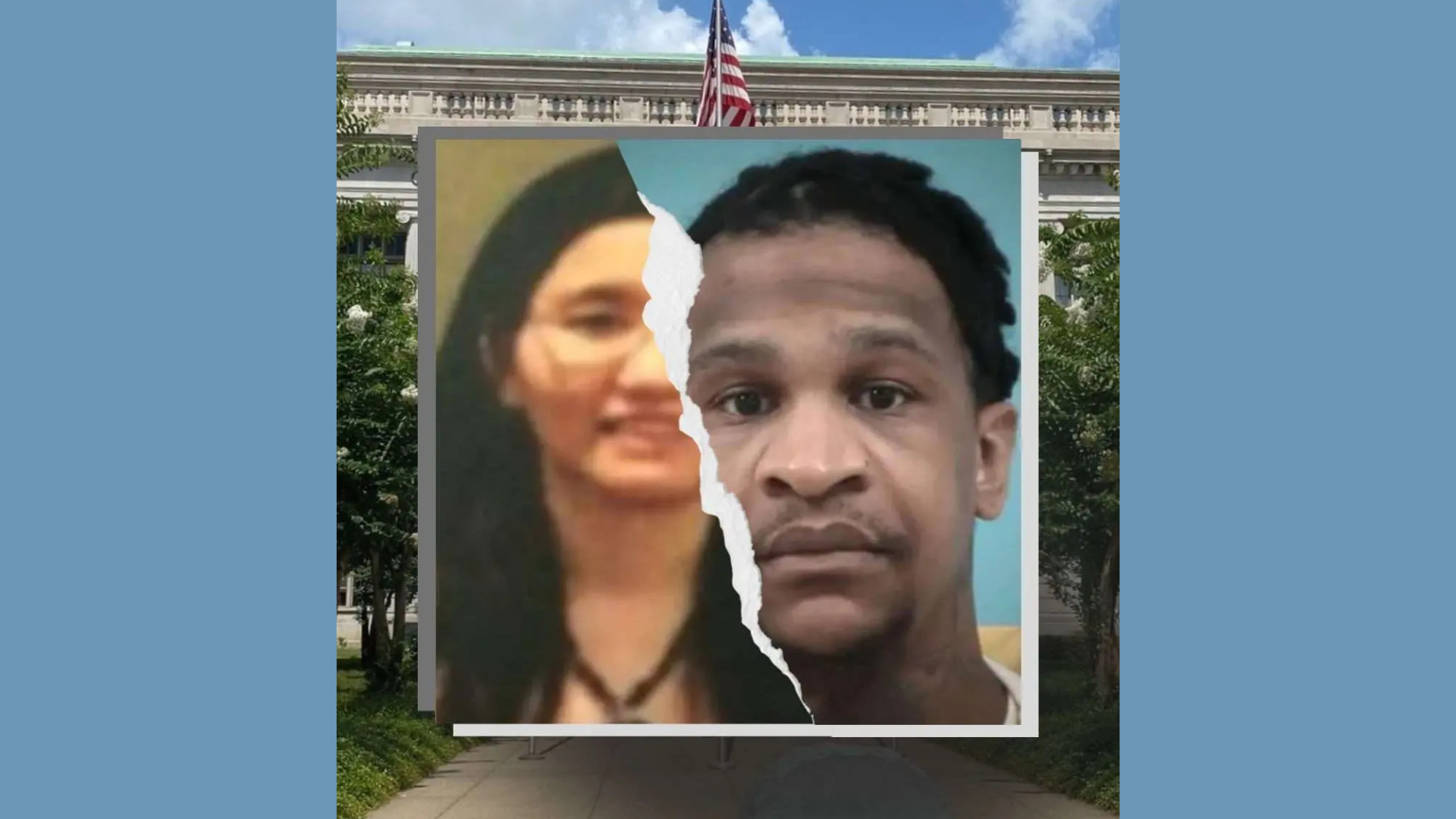
MONROE, La. — Closing arguments concluded Thursday in the bench trial of Quinton Tellis, charged with the 2015 murder of Ming Chen “Mandy” Hsiao, with the state painting a portrait of a calculated killer who tortured his victim for her PIN number and the defense arguing the case against their client amounts to little more than supposition built on a foundation of circumstantial evidence.
Judge Larry Jefferson will issue his ruling June 18 at 9 a.m. in Ouachita Parish court.
ADA Holly Jones opened her closing argument by returning to the theme she established at the outset of trial: that Mandy Hsiao was killed by a person devoid of emotion who wanted one thing, her money. She framed the case as a blank canvas filled in fact by fact until the full picture became undeniable.
“When using your reason and common sense, and looking at the existence of all of these facts, such facts will exclude any reasonable hypothesis of the defendant’s innocence,” Jones told Judge Jefferson.
Jones walked the court methodically through three distinct time periods: what investigators knew before Tellis’s first interview on August 11, 2015; what they learned between that interview and his second on August 19th; and what came to light after his arrest. At each stage, she argued, the evidence that emerged contradicted what Tellis had told police. And he had told police, repeatedly and emphatically, that he was telling the truth.
“I’m telling the truth, that I’m going to be straightforward and honest with you. I swear to God, I ain’t got no reason to lie to you. God can kill me right now, and I’m not lying about nothing. That’s on my grandma’s graveyard,” Jones quoted from his August 11th statement, before methodically laying out everything he had omitted from that interview: numerous Chase Bank calls, the fact that he knew Hsiao’s PIN number, the attempt to use Mohammed Mahrous as a money mule, the Vicksburg ATM withdrawals and his assertion that it wasn’t him in the surveillance photos of him, the Exxon receipt found in his home.
Jones saved her sharpest argument for the four phone calls made between 8:16 and 8:18 p.m. on July 29, 2015, two from Mandy’s iPhone and two from Tellis’s Nokia, all to the same Chase automated banking number, all within the same two-minute window. She noted that in six previous calls to Chase in May, Mandy had never once dialed a 1 before the 800 number. She knew she didn’t have to. On July 29th, both calls from her phone included the 1, because, Jones argued, whoever was dialing was reading the number off the back of the debit card, where it is printed with a 1 in front.
“The fact that the four phone calls occurred within the same minute, with the first two being made using Mandy’s cellular phone and the last two being made using the defendant’s cell phone, places Mandy and the defendant together at that point in time without question,” Jones said. “How do we know this? Because on August 8th, when they took all the evidence out of Mandy’s apartment, Mandy’s cell phone was still in the apartment.”
Jones argued that the presence of Mandy’s phone in the apartment on August 8th, combined with its use on the night of July 29th simultaneous with Tellis’s phone, left only one conclusion: he was there. And if he was there and left her alive, Jones said, there was no explaining what came next.
“If he allowed her to live, why in the world would she not immediately pick up the phone and call the police?” Jones said. “Because she was dead. Because he killed her. There is no other reasonable hypothesis.”
Jones addressed the DNA evidence directly, conceding there was none linking Tellis to the scene, but arguing the state of Mandy’s body after 10 days of decomposition in the Louisiana heat would have destroyed whatever was there. She also characterized the Y chromosome found in a rectal swab as not a DNA profile and not evidence of sexual assault, calling it a potential red herring, and noted that 17 people had their DNA tested in connection with the case and none were connected to the scene either.
On the testimony of Eric Hill, Tellis’s wife’s cousin who said Tellis called him from jail and told him to find someone to blame for Mandy’s murder, Jones argued Hill’s knowledge of details that were never made public, including the number and nature of the stab wounds, could only have come from Tellis himself. She acknowledged Hill had told multiple stories but said Detective Duane Cookson’s corroboration of the non-public details was the verification the court needed.
Jones closed by returning to the simplest question in the case. Mandy Hsiao sent a Facebook message at 7:41 p.m. on July 29, 2015. After that, nothing: no calls, no texts, no banking, no social media, no sign of life of any kind until her body was found on August 8th.
“What person in today’s society, especially a relatively young person, goes without making a cell phone call, making a text, signing onto Wi-Fi, looking at Instagram, checking Facebook? She didn’t touch nothing. Nothing was accessed after that time. She’s dead. And he did it.”
Defense attorney Bob Noel offered a sharply different reading of the same evidence, arguing the state had spent the entire trial trafficking in possibilities rather than proof.
“I’ve never been in a murder case where everything is supposition, guesswork, assumed as this case,” he told Judge Jefferson. “We’re in the proof business, Your Honor, and they haven’t proved anything.”
Noel challenged the timeline Jones had constructed around Katelyn Hearn’s testimony, putting heavy emphasis that Hearn had told police at one point that she heard a thud in Mandy’s bedroom and she thought it could have been between 9 and 9:30 p.m., not around 7:45 as the state suggested, and that she admitted on cross-examination it could have been as late as 8:06 p.m. before she arrived home. He also questioned whether Mandy was even home before her phone connected to a neighbor’s Wi-Fi at 8:13, noting that Facebook Messenger can be accessed from anywhere.
On the four phone calls, Noel suggested a scenario in which Mandy, having just discovered her card was missing, called Chase at the same moment Tellis was calling to access the account. He argued Tellis could have obtained the card any number of ways without ever entering her apartment, and could have seen her PIN when she used her card at Walmart, or she may have had her notebook with her containing the number.
“We have no burden to show how he got it,” Noel said. “They have the burden to prove how he got it.”
The absence of physical evidence was the cornerstone of the defense argument. No DNA belonging to Tellis was found anywhere in Mandy’s apartment. No blood was found in his car despite a Blue Star reagent test. No blood-stained clothing was ever recovered. Noel noted that those facts applied equally to every other person whose DNA was tested, and none of them were charged with murder.
Noel reserved his most pointed attack for Eric Hill, calling him the state’s star witness and arguing the entire murder case collapsed without him. He catalogued Hill’s shifting stories, four by his count, and highlighted what he called the ultimate lie: Hill’s claim to have testified at a prior Tellis trial. No such trial existed, Noel said.
“He has no credibility, Your Honor. Without him, they’ve got nothing but yet they’re guessing.”
Jones countered in rebuttal that Hill had been subpoenaed and present for a preliminary hearing and may have confused the terminology, and that his knowledge of non-public details about Mandy’s injuries was corroboration enough. She pointed out that Tellis had at least 10 days to dispose of any blood evidence between the time when Mandy was killed and when her body was discovered, even before he was first questioned on August 11.
Noel closed by invoking the Jackson v. Virginia standard, arguing that even viewing the evidence in the light most favorable to the state, the prosecution had not proven beyond a reasonable doubt that Quinton Tellis committed this murder.
Jones had the final word in rebuttal, returning to the four phone calls, the missing debit card, the silence that followed July 29th, and the question she said had no reasonable answer.
“There is no one else connected to Mandy and that credit card except for the defendant. There is no one else that was at that apartment with her on July 29th,” she said.
“The biggest tell-all is no electronic footprint after July 29th, 2015. She’s dead. And he did it.”
Judge Larry Jefferson will issue his ruling June 18 at 9 a.m. in Ouachita Parish.