MERIDIAN, Miss. (Queen City Newsfeed) Tropical Storm Isaias is churning in the Gulf of Mexico, and families across East Central Mississippi should not assume the coast will take the whole hit. Meridian sits about 150 miles from the Gulf, and Philadelphia sits even farther north. Still, history shows that hurricanes can carry damaging wind, flooding rain and tornadoes deep into the state.
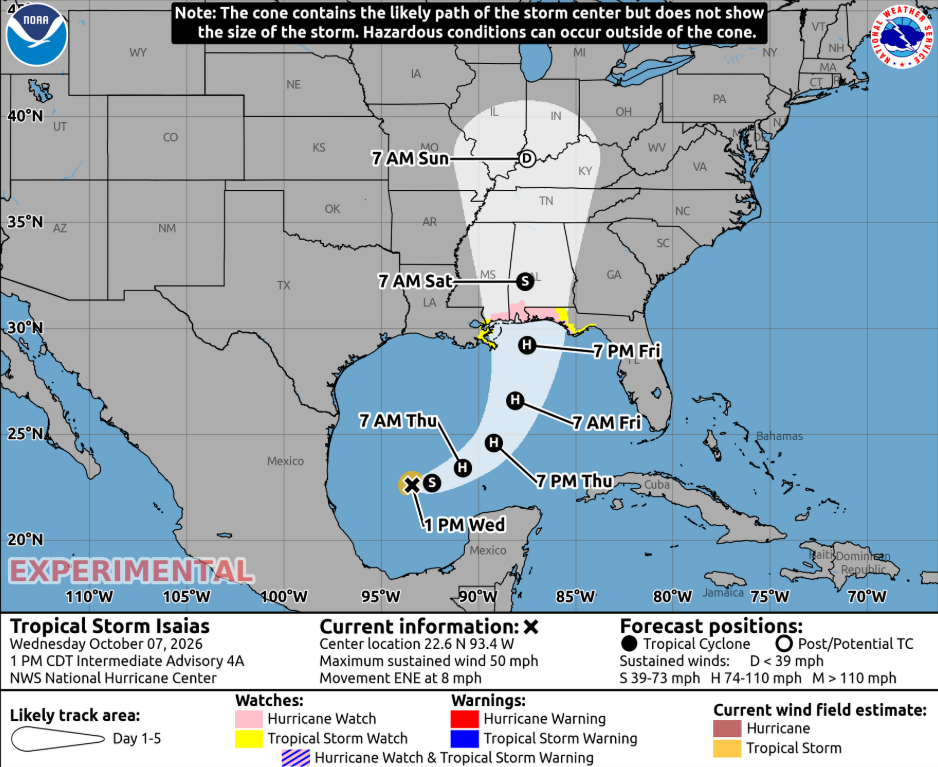
According to the Mississippi Emergency Management Agency, forecasters say Isaias could develop into a Category 2 hurricane and begin impacting the Mississippi Gulf Coast as early as Friday. MEMA warns that significant rainfall, flash flooding and other impacts could reach the state Friday and last through the weekend. Residents should follow the latest National Hurricane Center advisories for the storm’s exact track and timing, because even a small shift can change what reaches our area.
Now is the time to build a hurricane preparedness plan. Waiting until the storm reaches the coast leaves little time to buy supplies, fill gas tanks or secure a home.
The City of Meridian said it is monitoring the developing system and will share local updates as the forecast becomes clearer. “Now is the time to stay informed and make simple preparations. Being ready before bad weather arrives makes a difference,” Public Safety Director Greg Morgan said in a statement on the city’s Facebook page.
MEMA is coordinating with local emergency managers, the Mississippi Department of Public Safety and the Mississippi National Guard, and it will deploy resources as counties request them. Executive Director Stephen “Mac” McCraney said residents should not wait for a clearer forecast before taking action.
“The threat is real, and now is the time to prepare,” McCraney said. “We have seen how quickly tropical systems can impact Mississippi. Tropical Storm Arthur in June brought tremendous amounts of rain, flash flooding and significant damage.”
Why Inland Communities Need a Plan
Many people think of a hurricane as a coastal event. However, a strong, fast moving storm can hold onto tropical storm or even hurricane force winds well past the coastline. Hurricane Katrina proved that in 2005. The storm toppled trees across East Mississippi and left long lines at gas stations. Many residents went as long as two weeks without power, and some rural or heavily damaged properties waited close to a month for full restoration.
Wind is only part of the danger. Tropical systems often spin up quick tornadoes, especially on the eastern side of the storm. Because of the typical storm track, that eastern side often lines up with our part of the state. Heavy rain can also send local creeks and rivers out of their banks. In addition, soaked ground makes it easier for tall pine trees to fall onto homes, cars and power lines.
Start With a Family Communication Plan
First, decide how your family will stay in touch if cell service goes down. Choose one relative or friend who lives out of state to serve as a central contact. Long distance calls and texts sometimes go through when local lines are jammed.
Next, write important phone numbers on paper. A dead phone holds no useful contacts. Pick a meeting place in case your family gets separated. Finally, charge every phone and portable battery pack before the weather turns.
Build a Supply Kit for at Least Seven Days
MEMA recommends at least three days of drinking water and food for every member of your household. However, inland areas often wait longer for help because crews and resources focus on the coast first, so planning for a full week gives your family extra cushion. “Remember, the first 72 hours are on you,” McCraney said. “Do not assume help will arrive immediately.” A good kit includes:
- Water, at least one gallon per person per day
- Nonperishable food and a manual can opener
- A full supply of prescription medications, refilled before the storm
- A first aid kit
- Flashlights and extra batteries, rather than candles, which pose a fire risk
- A battery powered or hand crank NOAA Weather Radio
- Cash, since ATMs and card readers stop working without power
- Food, water and medicine for pets
- Baby formula, diapers and other infant supplies if needed
- Copies of insurance policies, IDs and other key documents in a waterproof bag
Prepare Your Home and Yard
Walk your property before the storm arrives. Trim dead limbs that hang over your roof, driveway or power lines. Bring in or tie down patio furniture, grills, trampolines and anything else the wind could throw. Also, clear gutters and ditches so rainwater has somewhere to go.
Then, take photos and video of your home and belongings. Those images make insurance claims much easier. Review your policy as well, because standard homeowners insurance does not cover flood damage. Flood coverage through the National Flood Insurance Program usually carries a 30 day waiting period. Buying it now will not help with this storm, but it will protect you next time.
Plan for Power Outages
Extended outages pose one of the biggest threats for inland residents. Fill your vehicle’s gas tank early, before coastal evacuees and nervous neighbors drain local stations.
If you own a generator, run it outdoors only. Keep it at least 20 feet from doors, windows and vents. Never run it in a garage, even with the door open. Carbon monoxide has no smell and can kill within minutes, so test your carbon monoxide detectors now.
Keep refrigerator and freezer doors closed as much as possible. A full freezer can keep food safe for about two days, while a refrigerator lasts only about four hours without power. Anyone who depends on oxygen or other powered medical equipment should make a backup plan now with their doctor and power provider.
What Local Power Companies Are Doing
East Mississippi Electric Power Association and Mississippi Power serve much of the Meridian and Philadelphia area. Both utilities shared how they are preparing for Isaias and what customers should know.
How EMEPA Is Preparing
EMEPA said its team is closely monitoring Isaias and preparing for possible outages and damage. “We have employees, equipment and response plans in place,” said Julie Boles, director of marketing and communications for EMEPA. EMEPA has already contacted its contractor partners for extra help. If damage turns out to be widespread, the cooperative can also request crews through its network of electric cooperatives, which send manpower and resources to one another after major storms.
When outages hit, EMEPA crews follow a detailed restoration plan that starts with the biggest repairs so the most members get power back first. Crews address generation, transmission lines and substations first, then move to distribution lines. Hospitals, fire stations and police stations also get priority. Individual service lines to homes come last. EMEPA said restoration time will depend on how much damage occurs and where, and it asks members to stay patient while crews work safely.
The cooperative urged members to treat every power line as energized and stay away from downed or damaged lines, including lines hidden by trees or debris. Members should report downed lines to 911 or EMEPA and warn others nearby. EMEPA also asked members not to cut any power or fiber lines while clearing debris.
On generator safety, Boles said members should “never connect a portable generator directly to your home’s wiring, because it can back feed electricity onto power lines and put our linemen at risk.” Generators also should never run in an enclosed area or in standing water.
EMEPA members can report an outage through the EMEPA app, through the outage map at EMEPA.com, by texting OUT to 601.483.7361 if their cell phone is linked to their account, or by calling 601.581.8600. Keeping contact information current on your account helps the system recognize your number and pull up your account faster. More storm tips are available in the Storm and Outage Center at EMEPA.com.
How Mississippi Power Is Preparing
Mississippi Power said its storm team has closely monitored Isaias for several days and is actively working on preparations and logistics. The utility has nearly 500 additional support resources ready, including extra line crews, vegetation management teams and damage assessors.
“While the current models continue to show a more eastward track, our customers should know that we remain in a strong place to respond should we see any impacts,” said Kaila Moran Griffith, spokeswoman for Mississippi Power. She noted that crews have responded to multiple severe weather events across the company’s service territory and traveled to New Jersey earlier this summer to help with restoration there.
When outages hit, Mississippi Power focuses on the areas and power lines that restore electricity to the most people in the shortest time. Hospitals, emergency services, public safety facilities and water and sewer stations get priority.
Moran Griffith urged customers to stay away from loose or dangling power lines after the storm. “Any power line could be ‘hot’ or energized. You can’t tell by just looking,” she said. Customers should report downed lines to Mississippi Power right away at 800.532.1502. The company also offers a webpage dedicated to generator safety.
Mississippi Power customers can check and report outages through the company’s online Outage Map and sign up for outage alerts for their home or business through its Storm Center. The utility also shares updates on its Facebook page. Mississippi Power encouraged customers to use Wednesday and Thursday to review their family storm plan and gather supplies.
Know Where You Will Shelter
Tornado warnings can come quickly during a tropical system, so pick your safe spot ahead of time. Choose an interior room on the lowest floor with no windows, such as a bathroom, closet or hallway.
Mobile and manufactured homes offer little protection from tornadoes or strong wind. People who live in them should plan to stay with friends, family or at a community shelter before the storm arrives. Watch for shelter announcements from county emergency management. MEMA also urges families to plan ahead for children, older adults, people with disabilities and pets in case they need to leave home.
Meanwhile, expect coastal evacuees to head our way. Hotels may fill, highways may slow down and stores may run short on supplies. Shop early, stay patient and check on elderly neighbors and anyone who lives alone.
Stay Informed
Use more than one way to receive warnings. A NOAA Weather Radio works even when power and cell service fail, and the MEMA mobile app offers another way to get alerts. Make sure Wireless Emergency Alerts are turned on in your phone settings. Follow the National Weather Service in Jackson, the Mississippi Emergency Management Agency and your county emergency management office. Local TV and radio stations will also carry updates. For preparedness information and the latest state updates, visit MSEMA.org.
Know the difference between a watch and a warning. A watch means conditions could develop. A warning means dangerous weather is happening or about to happen, and you should act right away.
Above all, never drive through flooded roads. Just six inches of moving water can knock an adult off their feet, and about a foot of moving water can carry away most cars. Turn around, don’t drown.
After the Storm Passes
The danger does not end when the rain stops. Stay away from downed power lines and report them to your utility. Treat every line as live. Use chainsaws with care, and avoid cutting trees that rest under tension.
Document any damage with photos before you start cleanup. Be wary of storm chasing contractors who knock on doors after a disaster. Get written estimates, check references and never pay the full cost upfront. You can verify a contractor’s license through the Mississippi State Board of Contractors.
A hurricane preparedness plan takes only a few hours to put together. For families in Meridian, Philadelphia and the surrounding communities, those hours can make a long, hot week without power far safer and easier to handle.
Queen City Newsfeed will continue to follow this storm and share updates as they become available.