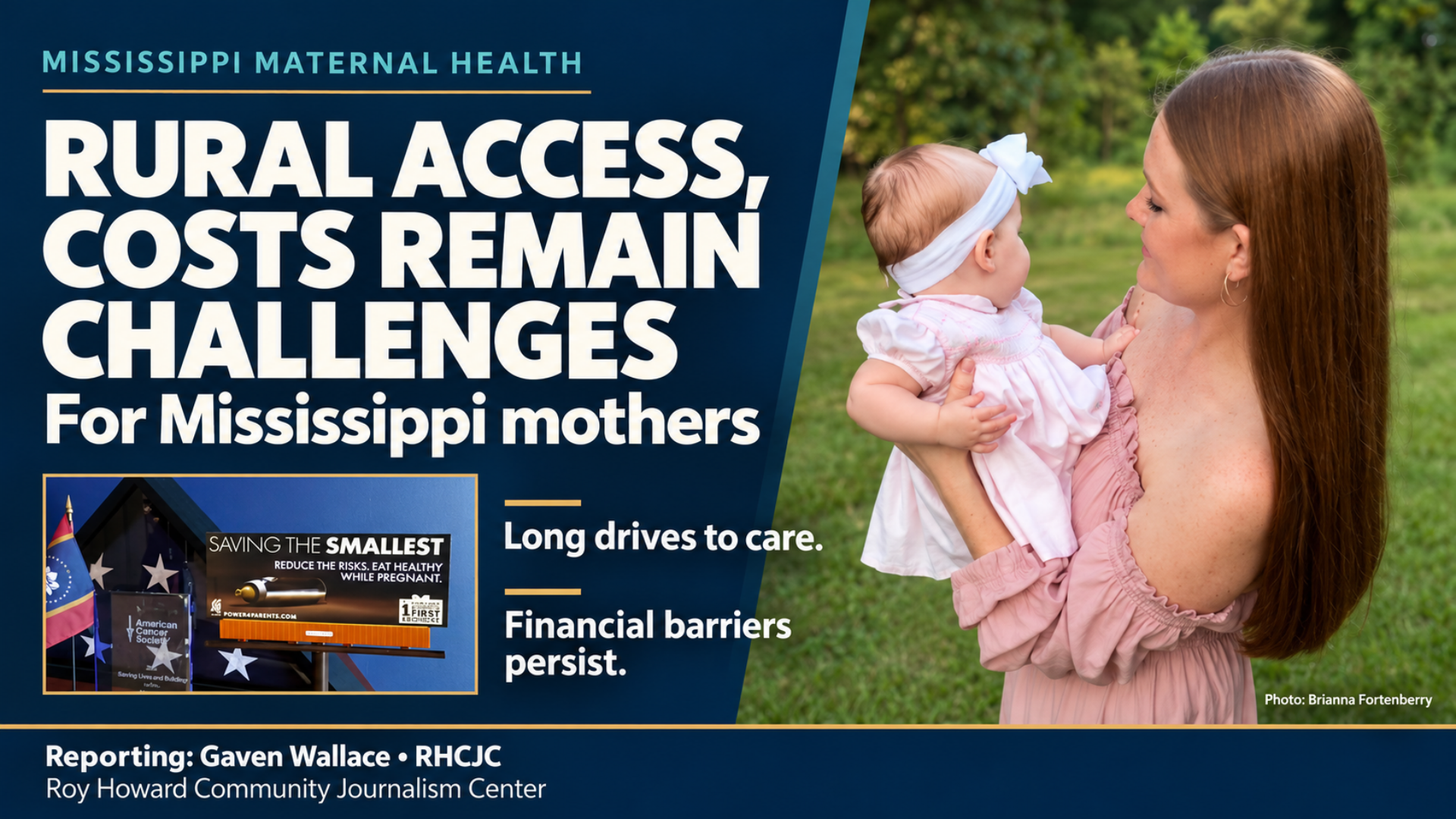
Mississippi ranks last in the nation for maternal and infant health outcomes, according to a March of Dimes report. State leaders are working to address geographic and financial barriers to care, while health officials say more needs to be done to make families aware of available resources.
When Columbia resident Brianna Fortenberry was pregnant with her daughter, she had to drive 33 miles to see an OB-GYN. The nearest birthing hospital, Forrest General in Hattiesburg, was 45 minutes away.

“As a first-time mother, especially wanting to go unmedicated, I was stressed. (The distance) was one of the most stressful thoughts for me,” Fortenberry said.
Dr. Daniel Edney, Mississippi’s state health officer, said rural communities often lack enough patients to financially support obstetricians or birthing hospitals.
“We have large areas of the state that have very low population density,” Edney said. “You still have pregnant moms in those areas, you just don’t have enough that could make economic sense for there to be an obstetrician or a birthing hospital or even licensed certified nurse midwives.”
Bridging the rural health care gap
Mississippi is addressing some of those gaps through the Rural Health Transformation Program, which provides grants to health care providers in counties with fewer than 50,000 residents.
The state received $205 million for the program. In September, Gov. Tate Reeves announced 167 grants totaling more than $104 million. At least six support prenatal or maternal health initiatives.
Edney said the program could help establish neonatal intensive care units, or NICUs, in the Delta and southwest Mississippi, where access to specialized newborn care is limited.
“We have birthing hospitals in these regions and we have nurseries, but we don’t have NICUs,” Edney said. “(The program) is an opportunity for those birthing hospitals to invest in (starting) up a NICU.”
But distance isn’t the only obstacle. The cost of care can also prevent mothers from getting the services they need.

Dr. Victoria Gholar, executive director of the Myrlie Evers-Williams Institute for the Elimination of Health Disparities, said giving birth without insurance can be financially overwhelming.
“I cannot imagine — even me with a full-time job — being able to cover the cost of having a baby without insurance,” Gholar said.
A 2026 Commonwealth Fund report found Mississippi has some of the nation’s highest uninsured rates across racial and ethnic groups. About 11.7% of white residents, 14.9% of Black residents and 41.1% of Hispanic residents lack coverage.
Expanding Medicaid coverage
Recent legislation has expanded Medicaid coverage for pregnant women.
In 2023, lawmakers extended postpartum Medicaid coverage from 60 days to 12 months. A 2024 law also established presumptive Medicaid eligibility, allowing qualifying pregnant women to receive up to 60 days of coverage while their applications are processed.

Women must meet income requirements, including a household income at or below 194% of the federal poverty level, to qualify for pregnancy-related Medicaid eligibility.
In 2025, the Mississippi Division of Medicaid also received a $17 million grant for a 10-year initiative to improve maternal and infant health outcomes.
Despite these expansions, Gholar said many eligible mothers remain unaware of available benefits.
“I’m very happy that presumptive eligibility is available. What I would like more of is for more people to know about it,” Gholar said.
Edney said more mothers are beginning to use expanded postpartum coverage, although improvements in maternal health may take time.
“Now we’re seeing it uptick, and we will see improvement in maternal health from that,” Edney said. “It’ll be a little bit further downstream, but it’s coming.”
This article first appeared on RHCJC and is republished here under a Creative Commons Attribution 4.0 International License.