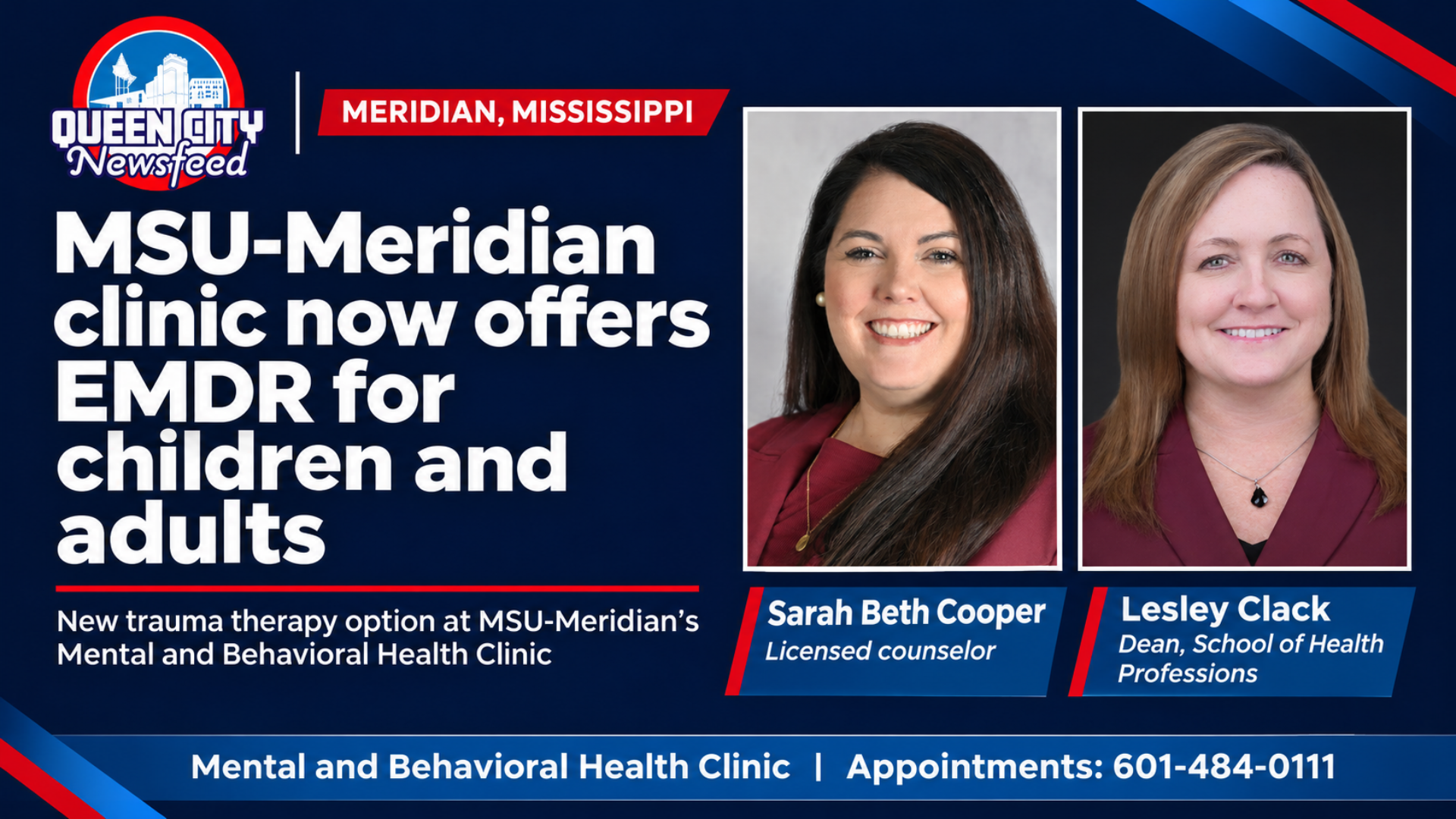
MERIDIAN, Miss. (Queen City Newsfeed) – A new Meridian trauma therapy option is now available for children and adults. Mississippi State University-Meridian says its Mental and Behavioral Health Clinic now offers EMDR.
EMDR stands for Eye Movement Desensitization and Reprocessing. This type of therapy is backed by research, and it treats symptoms tied to trauma.
Sarah Beth Cooper is a licensed counselor at the downtown clinic. She is also working toward advanced EMDR certification. Cooper said the therapy works with the brain’s natural ability to heal from hard events.
“Whenever there is a distressing or difficult experience in our life, our brain wants to heal and recover from it,” she said.
However, Cooper said overwhelming events can get in the way of that process. Those events can include accidents, abuse, loss or combat.
As a result, a person can get stuck in a loop. Cooper said that loop can lead to negative beliefs. It can also create feelings in the body and mind that bring the memories back.
“EMDR therapy helps to reprocess that trauma where that individual got stuck in that trauma loop,” she said. “EMDR takes the client’s hand and guides it down the healing path.”
How EMDR works
EMDR is different from regular talk therapy. It uses something called bilateral stimulation. That means a patient gets signals that switch back and forth between the left and right sides.
For example, patients may follow moving lights with their eyes. They may also hold small devices that pulse gently, or they may listen to sounds through headphones.
Cooper said this lets patients go back to painful memories in a safe, structured setting. As a result, those memories feel less intense.
The EMDR International Association says treatment has eight phases. At the clinic, patients start with an intake visit and then prepare for sessions. After that, they build coping skills and work on healthier beliefs. Finally, a score helps show whether treatment worked.
More options for families
The clinic also offers Trauma-Focused Cognitive Behavioral Therapy, or TF-CBT. This treatment is also backed by research. It was made mainly for children and teens.
Lesley Clack is dean of the MSU School of Health Professions. She said demand for EMDR has grown a lot. She also said offering more types of therapy helps clinicians meet each patient’s needs.
“No single therapeutic approach is appropriate for everyone,” Clack said. “Clinicians evaluate each patient’s circumstances before recommending treatment.”
The university said Clack has also finished intensive EMDR training.
Help with or without insurance
In addition, Clack said the clinic has added psychological assessments. These are tests and interviews that help explain a person’s mental health needs.
She said the clinic now takes Medicare, Medicaid and most insurance. It also has a sliding fee scale for clients with little or no insurance. A sliding fee usually sets the price based on income.
Clack said these changes show the clinic’s commitment to care that fits each person and is easy to reach. She said that goal is part of the university’s land grant mission to serve the public.
Cooper said she values the trust patients place in her.
“It’s such a rewarding experience,” Cooper said. “I always feel honored when people trust me with the worst thing that happened to them and to have a front row seat to their healing.”
How to make an appointment
The clinic is on the third floor of the downtown Regions building at 2121 5th St. It is open Monday through Friday from 9 a.m. to 5 p.m.
To schedule a visit, call 601-484-0111. You can also read the clinic’s directions online before you go.
If you or someone you know is in crisis, help is available at any hour. Call or text 988 to reach the 988 Suicide and Crisis Lifeline. In a life threatening emergency, call 911.