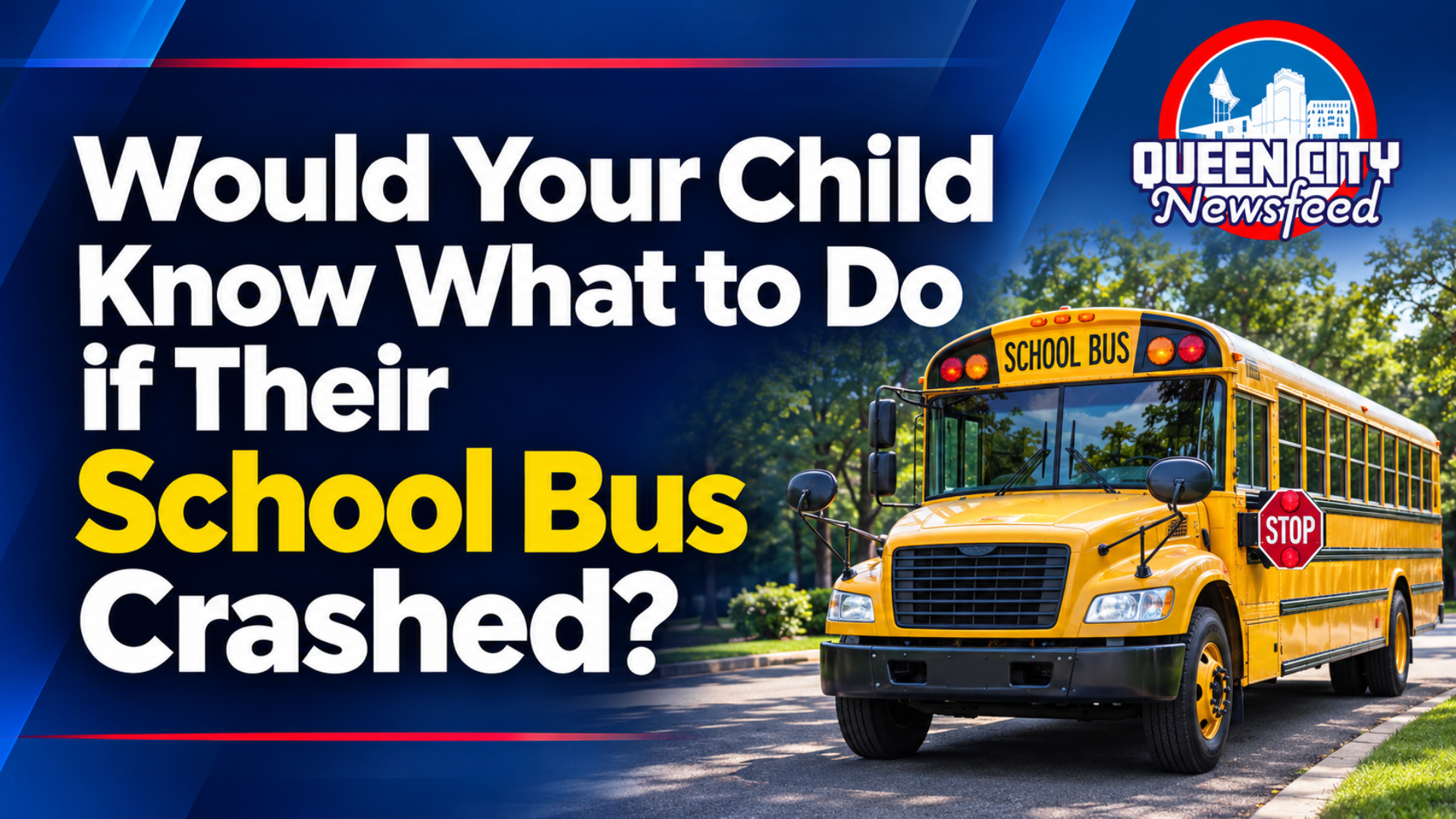
MERIDIAN, Miss. (Queen City Newsfeed) – After a string of crashes across Mississippi this fall, many parents may be thinking about school bus safety. Experts say the best time to teach your child what to do in a school bus crash is before one ever happens.
Recent crashes across the state
At least five school bus crashes have made the news in Mississippi since the middle of September. One of them happened close to home.
On Wednesday, a school bus and a log truck crashed in Noxubee County. The Noxubee County School District said students were hurt. They were taken to the local hospital to be checked.
Then on Friday, two more crashes happened in the Jackson area. In Flowood, a bus ended up in a ditch on Vine Drive near Northwest Rankin High School. The Rankin County School District said one student was being checked for injuries.
Earlier that morning, a Jackson Public Schools bus crashed at County Line Road and Ridgewood Road. Ridgeland Police Chief Brian Myers said no one was hurt, Darkhorse Press reported.
On Oct. 26, a Madison County Schools bus and another vehicle collided in Ridgeland. Police said 32 people were on the bus. Thirteen students went to the hospital, and parents took others to be checked.
The worst crash happened Sept. 15 in Lowndes County. A car pulled out in front of a bus on Highway 45 at Artesia Road, and the bus rolled over. Sixteen children and two adults were hurt, according to the Mississippi Highway Patrol. One child was flown to a hospital in Birmingham.
School buses are still a safe ride
Even so, school buses are one of the safest ways for kids to travel. That is according to the National Highway Traffic Safety Administration, or NHTSA. Fewer than 1 percent of all traffic deaths involve children on school buses and other school vehicles.
Large school buses are built to protect kids in a crash. The seats are strong and close together. Also, the seat backs are padded to soak up the force of a crash. Because of this design, NHTSA says large buses protect children even without seat belts.
However, crashes still happen. So it helps to practice at home.
Mississippi requires bus drills
The state already requires some training. Under Mississippi education rules, every bus driver must hold at least two evacuation drills each school year. An evacuation drill is a practice run. Everyone gets off the bus quickly and safely.
Parents can build on those drills at home. Keep your talks short and calm. You want your child to feel ready, not scared.
What to teach your child
School safety guides share the same basic steps. Go over these with your child:
Stay calm and stay seated. Do not get up until the driver says it is time.
Listen to the bus driver. The driver is trained for emergencies. He or she will tell you which way to go.
Leave your things behind. Book bags, lunch boxes and phones can wait. Grabbing them slows everyone down.
Walk. Do not run or push. Leave one seat at a time, in order.
Get far away from the bus. Georgia’s Department of Education teaches students to move about 100 feet away. That is about the length of three school buses.
Stay together. Wait as a group for the driver or another adult. That way, adults can count every child.
Tell an adult if someone is hurt. Tell the driver, a teacher or a first responder right away.
Good habits on every ride
Safe habits on a normal day also help in a crash. NHTSA’s training for bus drivers asks students to stay seated and face forward. Also, keep the aisle clear so no one trips on the way out.
If your child’s bus has seat belts, teach them to buckle up every time. Small school buses must have seat belts, NHTSA says.
Ways to practice at home
First, ask your child to name the exits on their bus. Most buses have a front door, a back door, emergency windows and roof hatches.
Next, play a “what would you do?” game at dinner. For example, ask what they would do if the bus stopped suddenly. Praise calm answers like “listen to the driver.”
Finally, ask your child’s school when the next bus drill is. Then talk about it with your child that night.
What parents should do after a crash
If your child’s bus is in a crash, watch for word from the school. After the Ridgeland crash, the Madison County School District said it was calling parents directly. Staff also worked to bring students and parents back together.
So keep your phone number and emergency contacts up to date with the school. Then follow the district’s directions about where to pick up your child.
A crash can be scary, even for kids who were not hurt. Give your child time to talk about it. If you have any worries about their health, call their doctor.
Drivers can help too
Every driver plays a part in keeping kids safe. In every state, it is against the law to pass a school bus when its red lights are flashing and its stop arm is out, NHTSA says. Yellow flashing lights mean the bus is about to stop, so slow down.
Questions?
Parents with questions can call their school district’s transportation office. Ask when bus drills happen. Also ask how the district will reach you in an emergency.