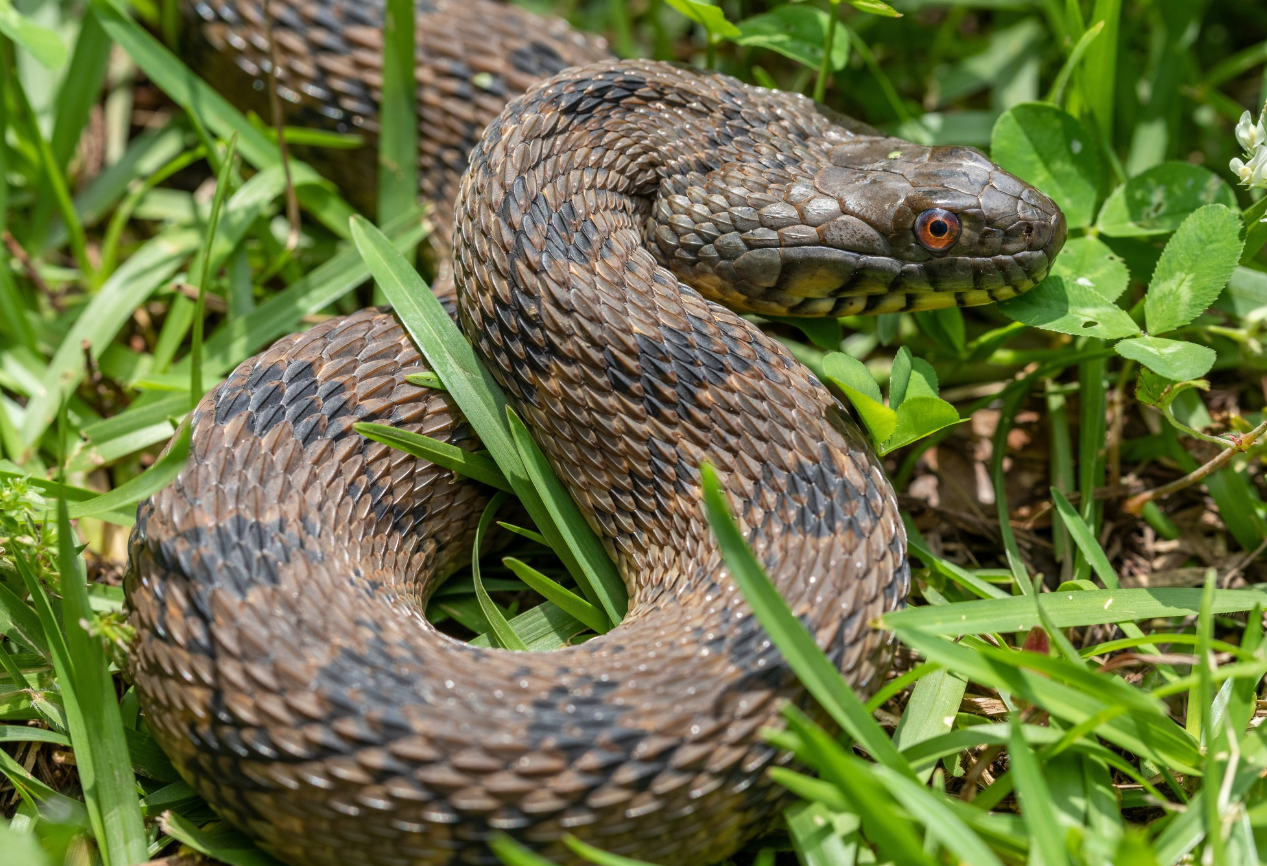
Mississippi has quite a few snakes. As summer brings more time outdoors and by the water, it’s important to know that not every snake you spot is a danger.
Mississippi Department of Wildlife Fisheries and Parks said that one commonly misunderstood reptile is the Diamondback Water Snake—often confused with the venomous Cottonmouth, but is actually harmless to humans.
While the Diamondback water snake may share a similar appearance to its venomous counterpart, the two have some key differences. And far from being a threat, the Diamondback plays a crucial role in keeping wetlands and fisheries healthy.
MDWFP said that these snakes primarily feed on fish and amphibians—especially catfish—and often eat dead, sick, or weak animals. This behavior helps maintain balance in aquatic ecosystems.
How to Tell the Difference:
If you’re trying to distinguish a Diamondback Water Snake from a Cottonmouth, here are two important clues:
-
Eyebrow Ridge: Cottonmouths have a prominent ridge called the canthus rostralis that gives their snout a sharply defined angle and hides their eyes from a top-down view. Diamondbacks do not have this, and their eyes are visible from above.
-
Lip Patterns: Water snakes like the Diamondback have vertical lines on both the upper and lower lip scales, while Cottonmouths typically have only three blotches on the lower jaw.
Next time you spot a slithery swimmer in the water, take a closer look before reacting—it could be a beneficial Diamondback just doing its job.
For more tips on identifying snakes in Mississippi, including venomous species, visit the Mississippi Department of Wildlife, Fisheries, and Parks’ Venomous Snake Guide.