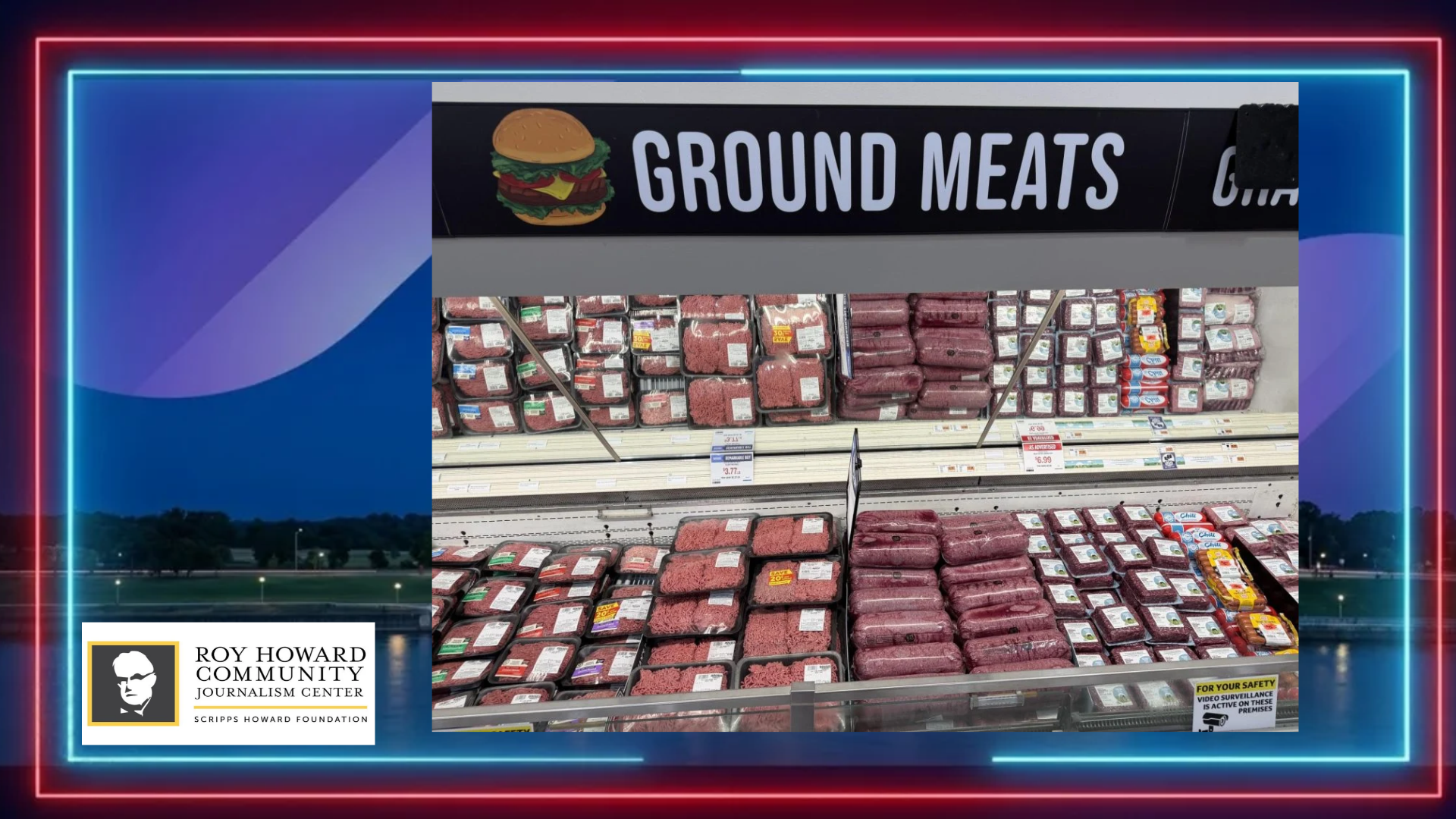
The Roy Howard Community Journalism Center’s “What Is True?” team investigated a claim that grocery stores are artificially inflating the price of beef.
RESULTS: The claim is unsubstantiated.

Beef prices rose 10% in the past year and 24% since 2024, according to Bureau of Labor Statistics. Overall, beef prices have more than tripled since 2020. To learn more about the causes of the rapid rise in prices, read the full fact-check below:
As Americans pay record prices for beef, the Justice Department expanded an antitrust investigation into major grocery retailers on Sept. 1 to determine whether stores were artificially raising prices.
While the Justice Department investigation is ongoing, industry experts at Mississippi State University Extension said there are “overlapping and numerous” reasons for high beef prices. One of the biggest factors is the rapid decline in the cattle population.
“Supply and demand are the big drivers here,” said Josh Maples, an associate professor in the Department of Agricultural Economics at Mississippi State University and a livestock economist for the Mississippi State University

Extension Service. “We’re at a 75-year low in terms of number of beef cows in the country. The connected thing is the demand for beef has been incredible the last couple of years. It’s the combination of those two that leads to higher prices.”
Ranchers report the cattle shortage stems from persistent drought in the western U.S., which reduced grazing land, along with higher feed and supply costs that pushed producers toward herd liquidation to cut costs.
“Costs have gone up, and if you’re expecting costs to remain or to even go higher, that pushes producers towards selling or liquidating their herds now, and that’s a headwind to expansion,” Maples said. “As a result, prices will continue to increase.”
The U.S. Department of Agriculture reports herd liquidation has slowed. However, Maples said it’s unlikely consumers will see relief in the near future because rebuilding herds takes time.
“Any decisions that are made at the farm right now to keep more calves, it’s at least two to three years down the road before that becomes more beef,” Maples said.
About “What Is True?”
The RHCJC “What Is True?” team of graduate investigators examines everything from viral online posts to local community rumors. If you have a question, submit it to the “What Is True?” inquiry form, call 855-IS-IT-TRU (855-474-8878) or text 601-266-TRUE (601-266-8783).
This article first appeared on RHCJC and is republished here under a Creative Commons Attribution 4.0 International License.