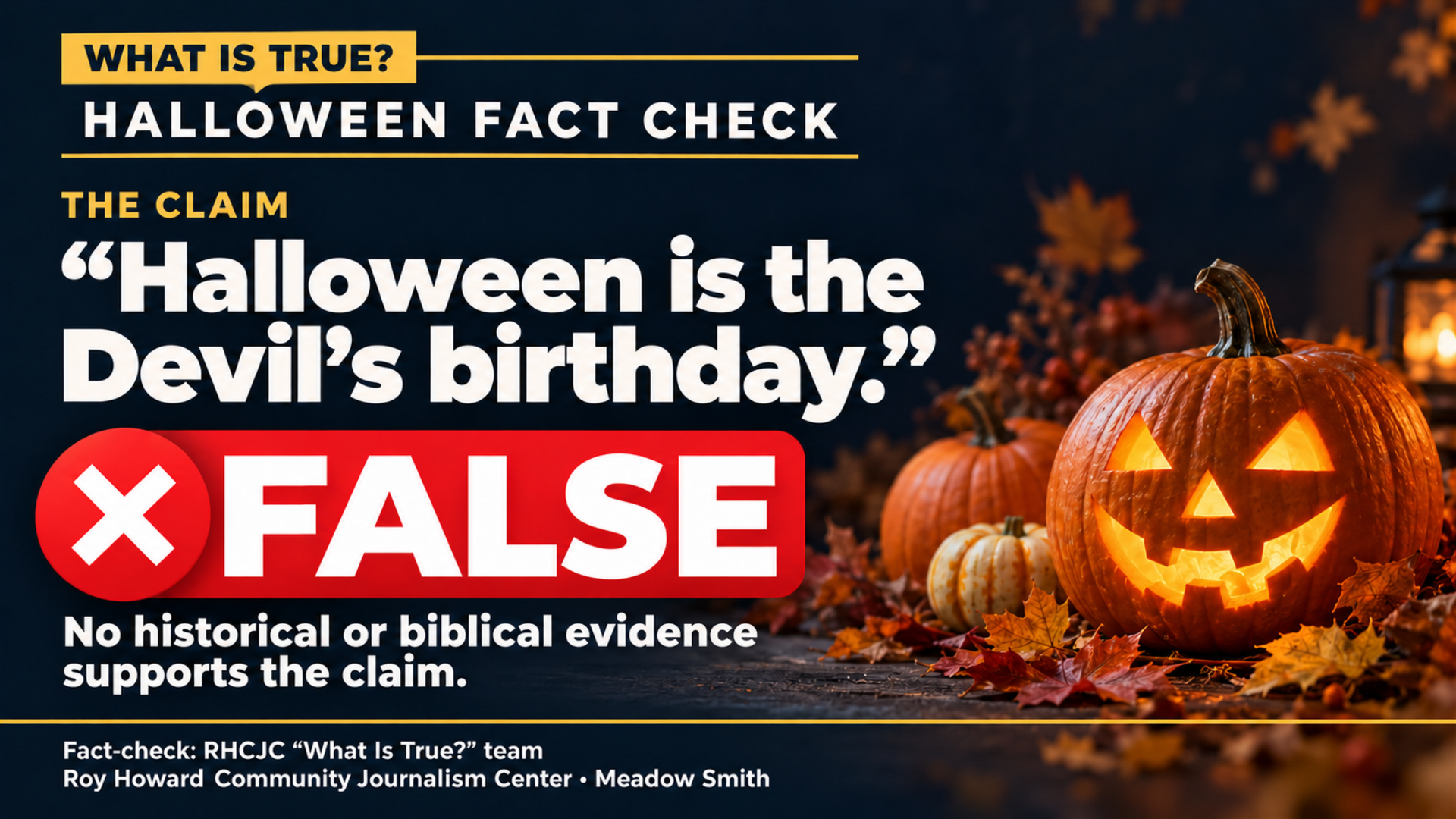
The Roy Howard Community Journalism Center’s “What Is True?” team investigated a social media claim that Halloween celebrates the Devil’s birthday.
RESULT: False
Historians trace aspects of modern Halloween to the ancient Celtic festival Samhain and Christian observances associated with All Hallows’ Eve. However, the Bible does not identify a date or festival season associated with the Devil’s creation or birth, and there is no historical evidence that Halloween marks his birthday. Read the full fact-check below.
Some people in the United Kingdom and United States say they grew up being told Halloween should not be celebrated because it was considered the Devil’s birthday.
Origins of Halloween
Halloween has roots in a variety of spiritual traditions that, over time, have come to include both pagan and Christian beliefs.
Modern Halloween has roots in the ancient Celtic festival Samhain, celebrated roughly 2,000 years ago to mark the end of summer and the beginning of winter. Some Celtic traditions held that the boundary between the living and spirit worlds was especially thin during this time. There is no historical evidence that the Christian Devil was the focus of these ritual practices.
Christian observances also influenced the holiday. By the ninth century, All Saints’ Day was observed on Nov. 1, with the preceding evening becoming known as All Hallows’ Eve.
Allhallowtide, a Christian observance honoring saints and remembering the dead, developed separately from Samhain. Over time, traditions associated with the observances influenced Halloween customs, although the extent of that influence remains debated.
Does Halloween celebrate the Devil?
The Bible does not identify a calendar date or festival season when the Devil was born or created.
A quote often attributed to Anton LaVey, founder of the Church of Satan, is sometimes cited in discussions about Halloween:
“I am glad that Christian parents let their children worship the devil at least one night out of the year.”
However, the “What Is True?” team did not find a verifiable primary source confirming LaVey made the statement.
Some pagan traditions observe Samhain, which has roots in non-Christian beliefs. Halloween, meanwhile, has been adopted by a variety of religious and secular communities.
Because Halloween draws on different cultural and religious traditions, its spiritual meaning varies among individuals and communities. However, there is no historical or biblical basis for identifyingHalloween as the Devil’s birthday or as a universally recognized day of Devil worship.
About “What Is True?”
The RHCJC “What Is True?” team of graduate investigators examines everything from viral online posts to local community rumors. If you have a question, submit it through the “What Is True?” inquiryform or call 855-IS-IT-TRU (855-474-8878).
This article first appeared on RHCJC and is republished here under a Creative Commons Attribution 4.0 International License.