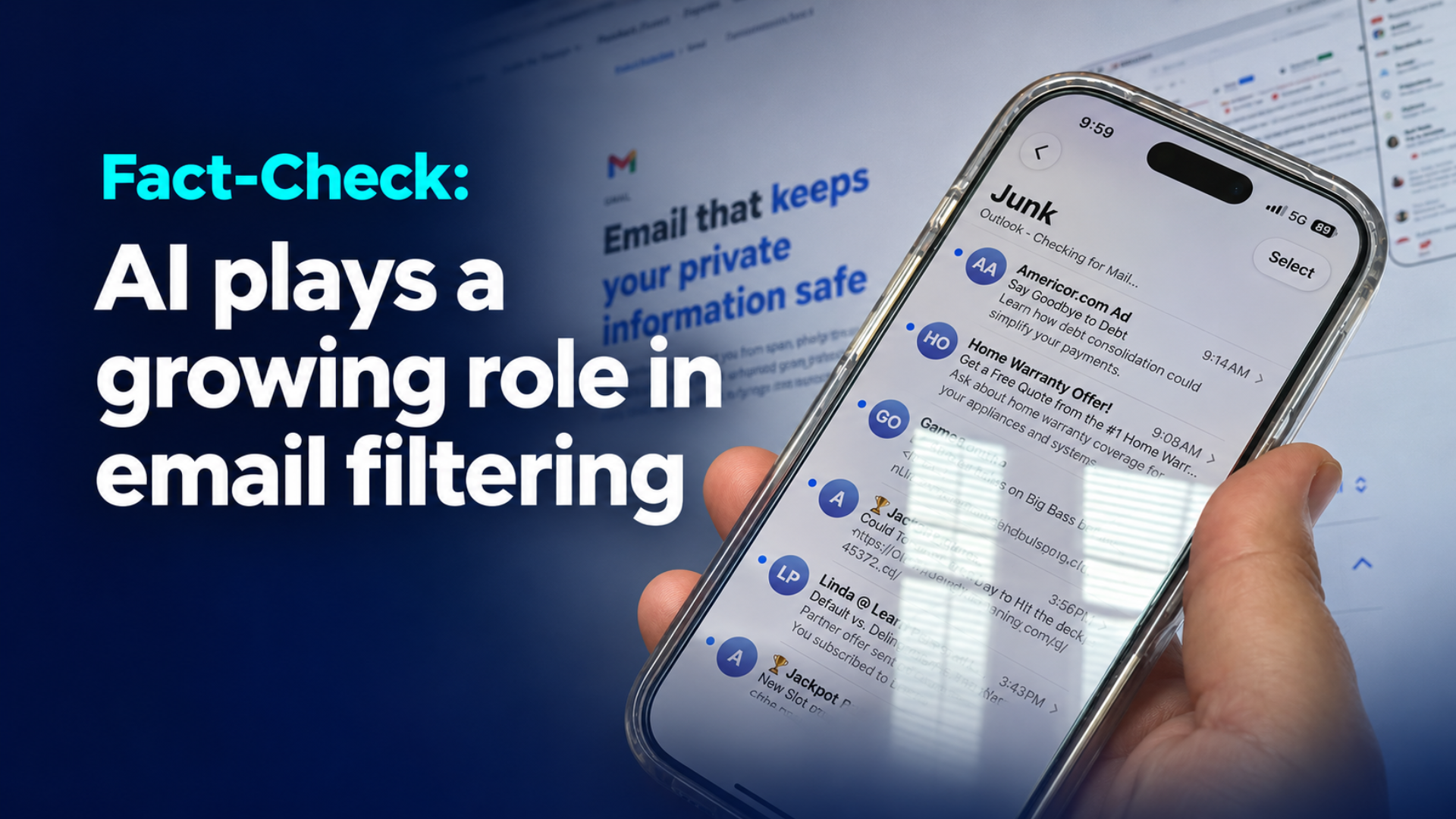
The Roy Howard Community Journalism Center’s “What Is True?” team investigated a claim that email providers are increasingly using artificial intelligence to filter incoming messages.
RESULTS: True

Major email providers are expanding their use of AI to identify spam, phishing attempts and other potentially harmful messages. While these systems can mistakenly flag legitimate emails, the available evidence does not establish whether increased AI use has led to more filtering errors. Read the full fact-check below:
Email providers, including Gmail and Microsoft Outlook, increasingly use artificial intelligence and machine learning to protect users from spam, phishing attacks and malicious attachments.
Modern spam filters analyze factors such as message content, sender reputation, authentication records and sending patterns. Messages from unfamiliar senders or newly established email accounts may receive additional scrutiny, although filtering practices vary by provider.
While designed to improve security, these systems can mistakenly flag legitimate messages.
Microsoft acknowledges more aggressive junk-email protection increases the risk of legitimate messages being classified as junk, and Google warns messages from legitimate email providers are not guaranteed to pass its spam filters.
However, the sources reviewed do not establish whether increased AI use has caused more legitimate emails to be incorrectly filtered.
Users can reduce the risk of missing important messages by taking these steps:
– Check spam and junk folders regularly.
– Mark legitimate messages as “Not spam” or “Not junk.”
– Follow up by phone or text to confirm receipt of important messages.
About “What Is True?”
The Roy Howard Community Journalism Center’s “What Is True?” team of graduate investigators examines claims ranging from viral online posts to local community rumors. Submit questions through the “What Is True?” inquiry form or call 855-IS-IT-TRU (855-474-8878).
This article first appeared on RHCJC and is republished here under a Creative Commons Attribution 4.0 International License.